
ADAPT
 |
Adapting fisheries management to climate change: a spatially explicit integrated population approach for seabass conservation |
|
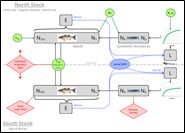
Human activities and climate change threaten ecosystem sustainability, affecting human and wildlife populations. Urgent actions are needed to mitigate these impacts. Marine ecosystems face numerous threats with climate change worsening in particular the impacts of fishing. The vulnerability of fish population to climate change requires innovative assessment tools to help fishery management to adapt to fish distribution and productivity changes. This PhD project will address these challenges using population dynamics theory, integrating demographic processes at individual, population, and ecosystem levels. The research focuses on the European seabass, a population already impacted by climate change, exploring (1) seabass metapopulation structure and connectivity, (2) spatiotemporal variations in population dynamics both in connection with climate change effects, and (3) marine spatial planning for climate adaptation and mitigation. The project will develop spatially explicit integrated population models within a state-space framework to assess climate impacts and management scenarios. Expected outcomes include climate-informed stock assessment models for seabass management and conservation, a useful tools for marine spatial planning to conciliate climate change, fishing, marine protected areas and offshore wind farms development.
People involved
 |
OLMOS Maxime, Phone : 02 98 22 49 78 Email : maxime.olmos@ifremer.fr |
 |
PENARD David, Doctorant(e) Email : david.penard@ifremer.fr |
 |
RIVOT Etienne, Scientist Phone : +33 2 23 48 59 34 Email : etienne.rivot@institut-agro.fr |
 |
WOILLEZ Mathieu, Phone : 02 29 00 85 65 Email : mathieu.woillez@ifremer.fr |
Funding and Support
DS Ifremer