
UNLOCK
 |
Unlocking Nature’s potential: Assessing the multi-faceted consequences of dam removal for biodiversity, water quality and territorial transitions |
|
Research
Aquatic ecosystems are essential for biodiversity and human well-being, but they face increasing threats like pollution, climate change, and dam construction. Dam construction is a controversial threat to aquatic ecosystems: producing hydroelectricity and creating new territorial opportunities while affecting water quality, biodiversity, and ecosystem functioning. The removal of dams has gained momentum in current policies as a solution to mitigate these impacts and to restore ecological health. Cases of restoration through complete dam removal are relatively rare, and knowledge of the mechanisms involved in restoring watercourses remains even more limited. Understanding the benefits and trade-offs associated with dam removal is crucial for informed decision-making in terms of environmental management. In an era where traditional ecological methods may not be sufficient to address the complex issues facing aquatic ecosystems, the UNLOCK project aims at leveraging insights from various disciplines to help design innovative and effective restoration strategies.
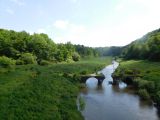
The Sélune River restoration in France is a remarkable example of a dam removal operation leading to ecological and territorial transitions. To assess the success of such restoration efforts, a scientific program was initiated in 2012, involving a multidisciplinary team of scientists specializing in various fields.
In this context, the primary objective of the UNLOCK project will be to utilize the comprehensive data collected since 2012 on the Sélune valley, both before and after dam removal, to evaluate the ecological and territorial consequences of dam removal. One PhD candidate and one 2- year postdoctoral fellow will focus on biodiversity, water quality, and societal aspects.
- The PhD project will consider various ecosystem components and evaluate the importance of examining spatial and temporal patterns to determine the success and mechanisms of recovery, with a particular emphasis on sediment dynamics, water quality, and the functional characteristics of aquatic and riparian communities.
- The postdoctoral project will serve a dual purpose. Firstly, it will assess the way local inhabitants and users interact with and make use of the newly transformed landscape resulting from the removal of dams on the Sélune River, taking into account social relationships and attachment to the environment. Secondly, it will seek to create a comprehensive historical inventory of the valley to understand the changes in ecological connectivity and biodiversity, focusing on mapping landscape units at the valley scale.
- In the end, the UNLOCK project will play a pivotal role in establishing spatially explicit and multi-faceted indicators, which evaluate the achievements in restoring the Sélune Valley. The outcomes of the UNLOCK project will offer valuable insights into the consequences of restoring rivers’ ecological continuities, and guidance for stakeholders which can be applied to similar scenarii worldwide.
People involved
 |
BERNEZ Ivan, Scientist Phone : +33 2 23 48 55 41 Email : ivan.bernez@institut-agro.fr |
 |
BOURDON Jérémy, Doctorant(e) |
 |
CHEVE Manuel, Ingénieur(e) de recherche Phone : +33 2 23 48 54 40 Email : manuel.cheve@inrae.fr |
 |
DÉZERALD Olivier, Scientist Phone : +33 2 23 48 54 46 Email : olivier.dezerald@inrae.fr |
 |
ROUSSEL Jean-Marc, Scientist Phone : +33 2 23 48 57 75 Email : jean-marc.roussel@inrae.fr |
 |
SOISSONS Laura, Scientist Phone : +33 2 23 48 54 40 / 06 19 75 56 60 Email : laura.soissons@inrae.fr |
Funding and Support
Projet ExcellencES IRIS-E financé par l’Agence Nationale de la Recherche au titre de France 2030 portant la référence « ANR-22-EXES-0008 »