
TELEPOMIMER+
 |
Telemetric survey of diadromous fish at sea - plus |
|
Research
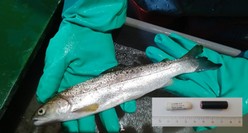
Knowledge about the marine life stages of diadromous fish is very limited, but there is considerable evidence supporting the hypothesis that pressures encountered at sea are contributing to the accelerated population decline being observed today. The development of offshore wind farms may be adding additional pressures (acoustic or electromagnetic disturbance, predation zones). However, positive effects cannot be ruled out (fishing exclusion zones, habitat diversity, and the potential presence of prey). Using an acoustic telemetry protocol, this project aims to generate the first insights into the use of offshore wind farms as passageways or feeding habitats by sea trout in the post-smolt juvenile stage. Between 2026 and 2027, approximately 100 individuals captured during their downstream migration will be equipped with transmitters at the facilities of the “Diadromous Fish in Coastal Rivers” Environmental Research Observatory of the Bresle River, a small coastal river flowing into the English Channel at Le Tréport (Seine-Maritime). They will be tracked using a network of hydrophones deployed in various offshore wind farms in the Channel, notably the new Dieppe-Le Tréport wind farm and the Baie de Seine wind farms, as well as through shared receivers in the ETN (European Tracking Network). Some individuals—among the largest—are also equipped with temperature and pressure biologgers with the aim of recapturing them and using the data to develop models of their marine movements.
The questions this project will address are as follows: Do juvenile sea trout circulate within or in the immediate vicinity of the wind farms? What is their residence time in these areas? Do these behavioural patterns differ at sites equipped with hydrophones outside the wind farms? This project will have strong synergies with the TELEPOMIMER project, which focuses more specifically on the adult phase, and more generally with the Fishowf+ project (2024–2027), which covers a much broader range of target species. It is a continuation of another DECOD project (SAMARCH 2017-2023).
Parternships
DECOD internal partnership:
IFREMER (Mathieu Woillez)
Partnerships outside DECOD:
OFB/UAR Patrinat & Pôle MIAME (Anthony Acou)
OFB (Quentin Josset)
France Energie Marine (Lydie Couturier)
Muséum National d’Histoire Naturelle (Céline Artéro)
European Tracking Network
Ocean Tracking Network
People involved
 |
LASNE Emilien, Scientist Phone : + 33 2 23 48 54 44 Email : emilien.lasne@inrae.fr |
 |
MICHELOT Armand, Technician Phone : +33 2 23 48 52 37 Email : armand.michelot@inrae.fr |
 |
WOILLEZ Mathieu, Phone : 02 29 00 85 65 Email : mathieu.woillez@ifremer.fr |
Funding and Support
Agence de l’Eau Seine Normandie (AAP ‘Biodiversité et éolien en Manche) : 325 050 €
UAR Patrinat : 23 240 €
INRAE : 36 729 €