
M&M
 |
Mesocosms and Macroduration : better predict success and impacts of biological invasions |
|
Research
Biological invasions destroy biodiversity and incur significant economic costs. To improve our ability to predict biological invasions and their impacts on ecosystems, DECOD has launched the Mesocosm and Macro-duration (M&M) project.
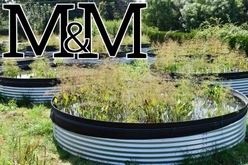
M&M combines the compilation of food webs published in the scientific literature with a long-term experiment (2020–present) in 12 aquatic mesocosms to simulate an invasion by the red swamp crayfish (Procambarus clarkii), a globally invasive species. The experiment is taking place at the U3E’s PEARL experimental platform (INRAE, Rennes). Four mesocosms serve as uninvaded controls, four contain crayfish, and four contain crayfish subjected to exploitation that simulates management through attempted eradication, the most commonly employed mitigation measure. Apart from this exploitation, the mesocosms are not subjected to any other manipulation and behave like natural ponds in which all animal and plant populations are maintained naturally.
Since 2021, monitoring programmes have been recording the physical and chemical parameters of the water, as well as the composition of biological communities, using methods that combine multi-parameter probes, aerial photography, in situ sampling, and deep-learning image analysis approaches that have led to technological advances (Jaballah et al. 2023; Walter et al. In press)..
M&M is led by 10 permanent staff members at DECOD Rennes, involves two collaborations with the University of Rennes and several international partnerships, forms part of the ANR BackOut project (2026–2029), and supports the ongoing PhD theses of Emilien Gaigné (2024–2027) and Mingjun Feng (2024–2028).
References:
- Jaballah S, Garcia GF, Martignac F, et al (2023) A deep learning approach to detect and identify live freshwater macroinvertebrates. Aquatic Ecology. https://doi.org/10.1007/s10452-023-10053-7
- Walter H, Gorzerino C, Collinet M, et al (In press) PlanktonFlow : hands-on deep-learning classification of plankton images for biologists. PCI Ecology. https://doi.org/10.1101/2025.09.19.677346
Scientific partners
- INRAE U3E (Unité Expérimentale d'Ecologie et d'Ecotoxicologie Aquatiques), Rennes, France
- UMR ECOBIO (Ecosystèmes, Biodiversité et Evolution), CNRS, Université Rennes 1, Rennes
- UMR BioSP (Biostatistique et processus SPatiaux), INRAE, Avignon, France
- UMR EGCE (évolution, génomes, comportement et écologie), CNRS, Université Paris-Saclay, France
- CEES (Center for an Ecological and Evolutionary Synthesis), Université d’Oslo, Norvège
- Université d’Oxford, Oxford, Grande Bretagne
- Department of Ichthyology & Aquatic Environment, Université de Thessalie, Grèce
- Institut d’écologie aquatique, Centre de recherche en écologie, Budapest, Hongrie
- Rubenstein School of Environment and Natural Resources, Université du Vermont, Burlington, USA
People involved
 |
AMILIEN Flavie, Technician Phone : +33 2 23 48 56 69 Email : flavie.amilien@inrae.fr |
 |
COLLINET Marc, Technician Phone : +33 2 23 48 55 29 Email : marc.collinet@inrae.fr |
 |
COUDREUSE Julie, Scientist Phone : +33 2 23 48 55 43 Email : julie.coudreuse@institut-agro.fr |
 |
DÉZERALD Olivier, Scientist Phone : +33 2 23 48 54 46 Email : olivier.dezerald@inrae.fr |
 |
EDELINE Eric, Scientist Phone : +33 2 23 48 55 23 Email : eric.edeline@inrae.fr |
 |
FENG Mingjun, Doctorant(e) Phone : +33 7 82 58 35 99 Email : mingjun.feng@inrae.fr |
 |
FOURCY Damien, Scientist Phone : +33 2 23 48 70 09 Email : damien.fourcy@inrae.fr |
 |
GAIGNÉ Emilien, Doctorant(e) Email : emilien.gaigne@inrae.fr |
 |
GORZERINO Caroline, Scientist Phone : +33 2 23 48 70 37 Email : caroline.gorzerino@inrae.fr |
 |
KETAVONG Setha, Technicien de recherche Email : setha.ketavong@inrae.fr |
 |
PETIT Eric, Scientist Phone : + 33 2 23 48 70 36 Email : eric.petit@inrae.fr |
 |
PORCON Béatrice, Technicienne Phone : +33 2 23 48 56 69 Email : beatrice.porcon@inrae.fr |
Funding and Support
Autofinancement DECOD ; ECODIV INRAE/Région Bretagne (Bourse de thèse E. Gaigné) ; China Scholarship Council CSC (Bourse de thèse M. Feng)