
TELEMETRIE
 |
Telemetric assessment of pre spawn Atlantic salmon Salmo salar migration in the Sélune river in a dam removal context |
|
Research
Background and Issues
Diadromous fish populations are under threat worldwide. In addition to historical factors such as habitat fragmentation caused by the construction of barriers like dams and weirs, there are now factors related to climate change. Changes in thermal and hydrological regimes pose a direct threat by affecting fish physiology or habitat quality, as well as by exacerbating the effects of habitat fragmentation.
The overall objective of this project is to understand how amphihaline fish respond to this combination of pressures. The chosen study site—the Sélune basin—offers a unique context for addressing this issue given the ongoing process of restoring connectivity.
Objectives
This project focuses on Atlantic salmon. One of the key challenges regarding this species is to characterize the habitats they use and the physicochemical and hydrological conditions they encounter. At present, little is known about the behaviour of salmon during their spawning migration in rivers, particularly those in the Bay of Mont Saint Michel. Previously available data suggested that a significant proportion of the fish do not reach the spawning grounds until late in the fall, including multiple sea winter individuals arrived in the watershed as early as spring. Thus, the salmon would spend several weeks or even months in the downstream sections where the physicochemical and biotic conditions are potentially stressful.
Methodology
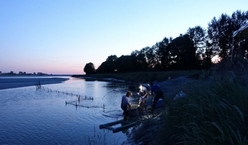
Salmon are captured as soon as they arrive in the Sélune estuary and equipped with radio transmitters combined to biologgers. In addition to transmitting a radio signal for tracking purposes, these devices record temperature, pressure, and acceleration. Individuals are tracked weekly via mobile tracking, as well as through fixed receivers installed at strategic locations in the watershed and adjacent basins (Sée, Couesnon).
Results
From 2019 to 2023, 143 individuals were tagged in early summer in the Sélune estuary and then tracked until spawning in December. The results show high mortality among tagged fish (between 26% and 83%) during the summer months. On average, nearly one-third of tagged individuals leave the Sélune for adjacent rivers. Rapid recolonization by salmon of areas newly accessible following the removal of the last dam in 2022 is also observed. Data on temperature, acceleration, pressure, and heart activity provide valuable insights into the behaviour of individual fish and their responses to the conditions they encounter. Body temperature measurements show that summer thermal conditions in the Sélune are sometimes very high for salmon according to standards in the literature.
Publications issued from the project
Lasne Émilien, Forget Guillaume, Anfray Mathieu, Chaubet Théo, Deroyer Kevin, Michelot Armand, Tremblay Julien, Martignac François (2025). Combining telemetry and biologging to study the ecophysiological response of migratory to anthropogenic pressures. Sciences Eaux & Territoires, 47, pp.8443, 2025, ⟨10.20870/Revue-SET.2025.47.8443⟩
People involved
 |
FORGET Guillaume, Scientist Phone : +33 2 23 48 56 25 Email : guillaume.forget@inrae.fr |
 |
LASNE Emilien, Scientist Phone : + 33 2 23 48 54 44 Email : emilien.lasne@inrae.fr |
 |
MARTIGNAC François, Scientist Phone : +33 2 23 48 56 25 Email : francois.martignac@inrae.fr |
 |
MICHELOT Armand, Technician Phone : +33 2 23 48 52 37 Email : armand.michelot@inrae.fr |
 |
WOILLEZ Mathieu, Phone : 02 29 00 85 65 Email : mathieu.woillez@ifremer.fr |
Funding and Support
OFB : 403 587 €
INRAE : 294 166 €
ECODIV : 29 000 €
DECOD : 3 500 €